Here is your quick look at the most important shifts happening across the tech and AI landscape right now. We break down the latest funding concentration, a new ensemble AI tool to check out, and a practical workflow to help you make better product decisions.
1️⃣ Massive mega-rounds and the compute bundle.
2️⃣ CollectivIQ for ensemble decisions.
3️⃣ Building an AI model committee.
4️⃣ The two-tier market and the end of the single AI oracle.
1️⃣ Massive mega-rounds and the compute bundle.
AI mega-rounds concentrate around frontier players
Capital is increasingly flowing into massive AI rounds, often exceeding $1 billion. These funds target frontier-model labs, infrastructure platforms, and highly automated software firms. Meanwhile, most standard startups face tighter, slower funding environments.
For example, AMI, an early-stage project exploring alternative AI paradigms like world models and advanced reasoning, reportedly raised over $1 billion. This signals a strong investor willingness to fund architectures beyond classic LLMs.
Furthermore, top-tier venture rounds now frequently bundle capital with compute access and cloud alliances. Having direct access to GPUs, data centers, and energy is now just as decisive as the financial term sheet itself.
2️⃣ CollectivIQ for ensemble decisions.
CollectivIQ
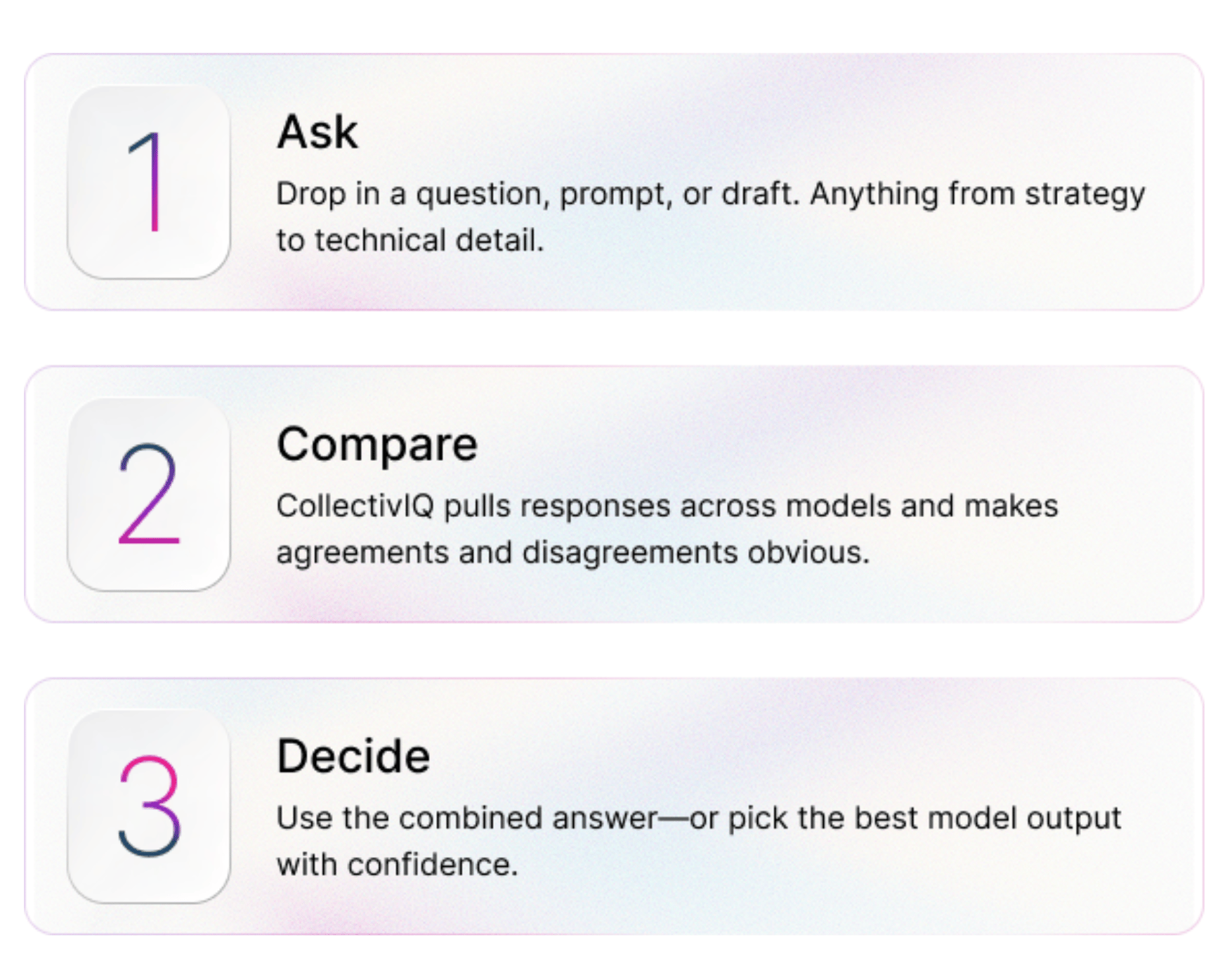
CollectivIQ is an AI ensemble decision platform built to de-risk high-stakes business choices.
What it does: It runs multiple AI models in parallel on the exact same question. It then cross-checks the answers and surfaces a consensus complete with explanations.
Who it serves: Founders, product managers, and data teams who make high-impact decisions around pricing, risk, and strategy.
Why it matters right now: Capital is concentrating around high-stakes AI, and enterprises are leaning heavily on models for core decisions. Ensemble approaches act as a vital hedge against model failure, hallucinations, and provider lock-in.

3️⃣ Building an AI model committee.
Create a “model of record” committee using ensemble AI
You can stop relying on a single AI model for product decisions. Build an ensemble workflow to get a more reliable consensus.
Pick a high-impact decision: Choose a recurring challenge, such as deciding which customer segments to prioritize next quarter or which incidents need immediate engineering attention.
Query multiple models: Send the exact same structured prompt and context data to two or three different models. You can use an ensemble tool or write a simple script to query options like GPT, Claude, and open-weight models simultaneously.
Aggregate the responses: Have your tool or script compare the answers, flag any disagreements, and produce a concise consensus recommendation with a rationale from each model.
Review with human experts: Bring the AI consensus to your weekly operations meeting. Review it alongside human input. Explicitly log instances where your team overrides the AI and document why. This creates a valuable feedback dataset.
Track and expand: Over a month, track where the ensemble guidance matched or beat human-only baselines. Once you see a measurable lift in metrics, expand the ensemble approach to adjacent areas like pricing experiments and risk scoring.
4️⃣ The two-tier market and the end of the single AI oracle.
The latest funding data confirms that AI is now a two-tier market. A small group of frontier and infrastructure projects absorbs massive rounds bundled with massive compute power. Everyone else competes under strict scrutiny. This dynamic raises the bar for all tech teams. Deep technical differentiation, efficient compute usage, and tight platform integrations matter more than ever.
At the same time, tools like CollectivIQ show how enterprises plan to de-risk their AI dependence. Best practices are shifting toward “AI panels” instead of relying on a single oracle. For developers and IT leaders, you need to architect against multiple models by default. You must instrument your decisions for measurable impact and treat GPU access as a core part of your technical strategy.
Help us spread the word!
If you found this breakdown useful, please forward it to a colleague or share it with your team.
We also want to hear from you. Reply to this email and let us know: What decision area (product, infrastructure, operations, or go-to-market) would be most valuable to see a concrete ensemble-AI workflow for next week?